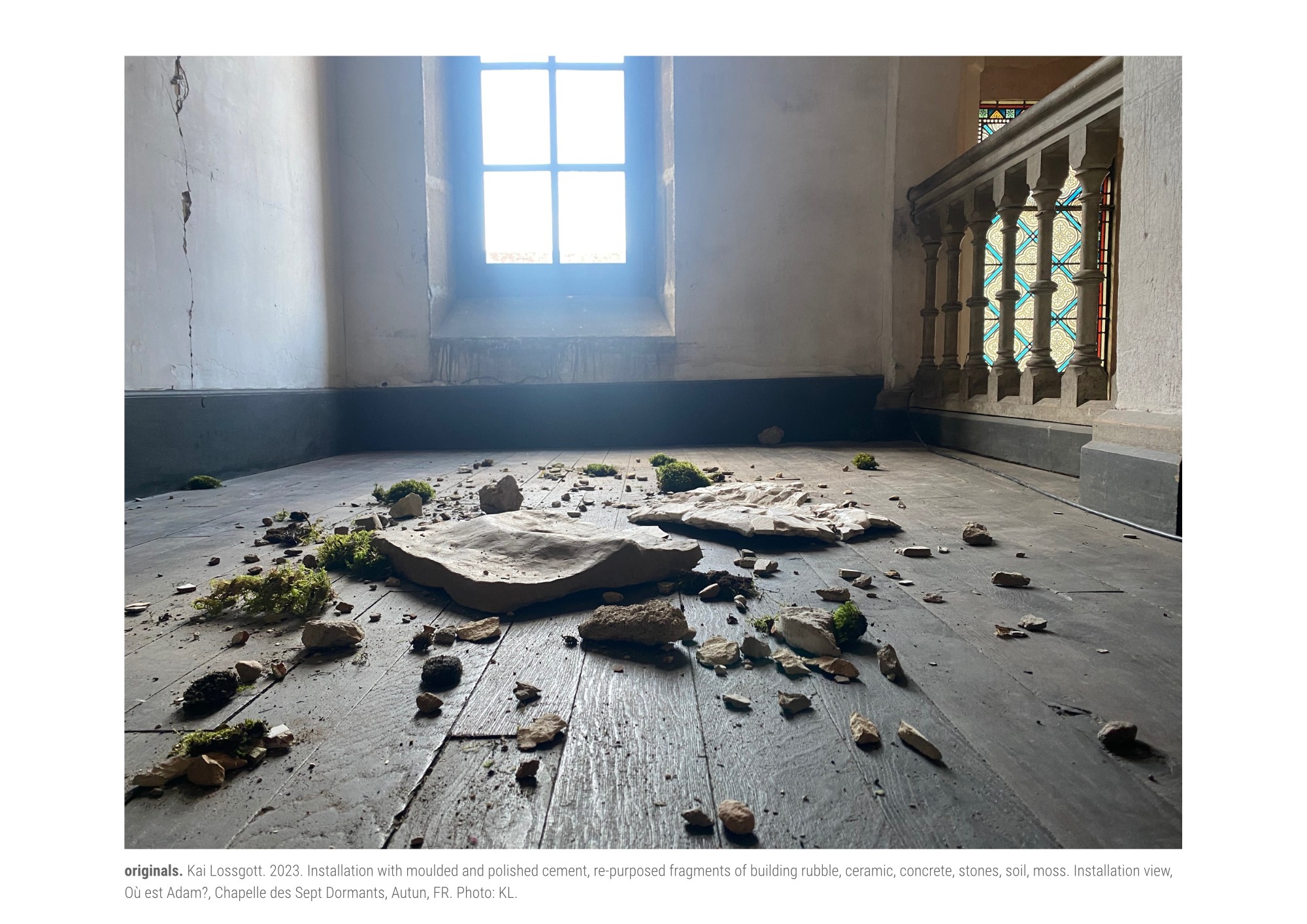
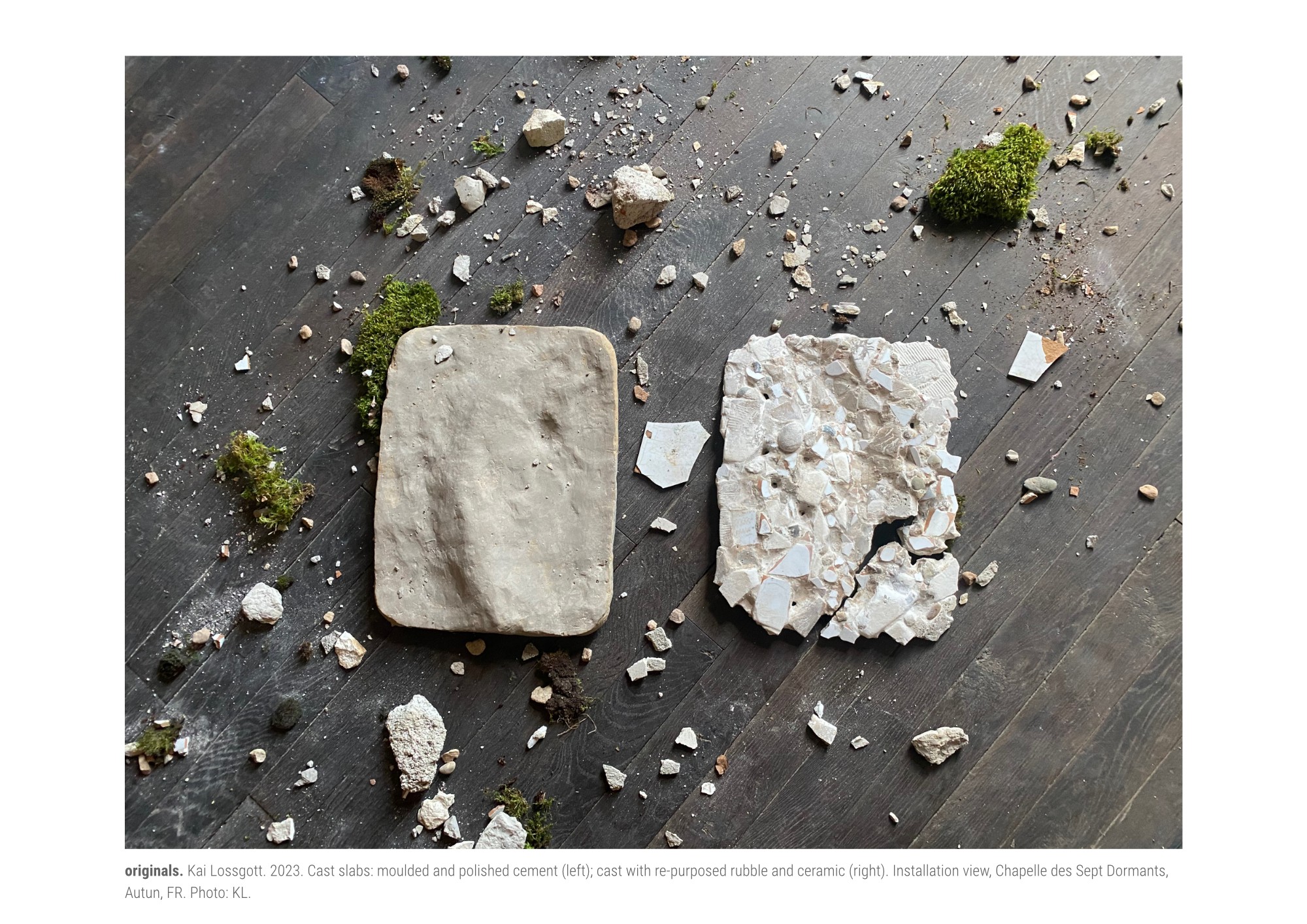
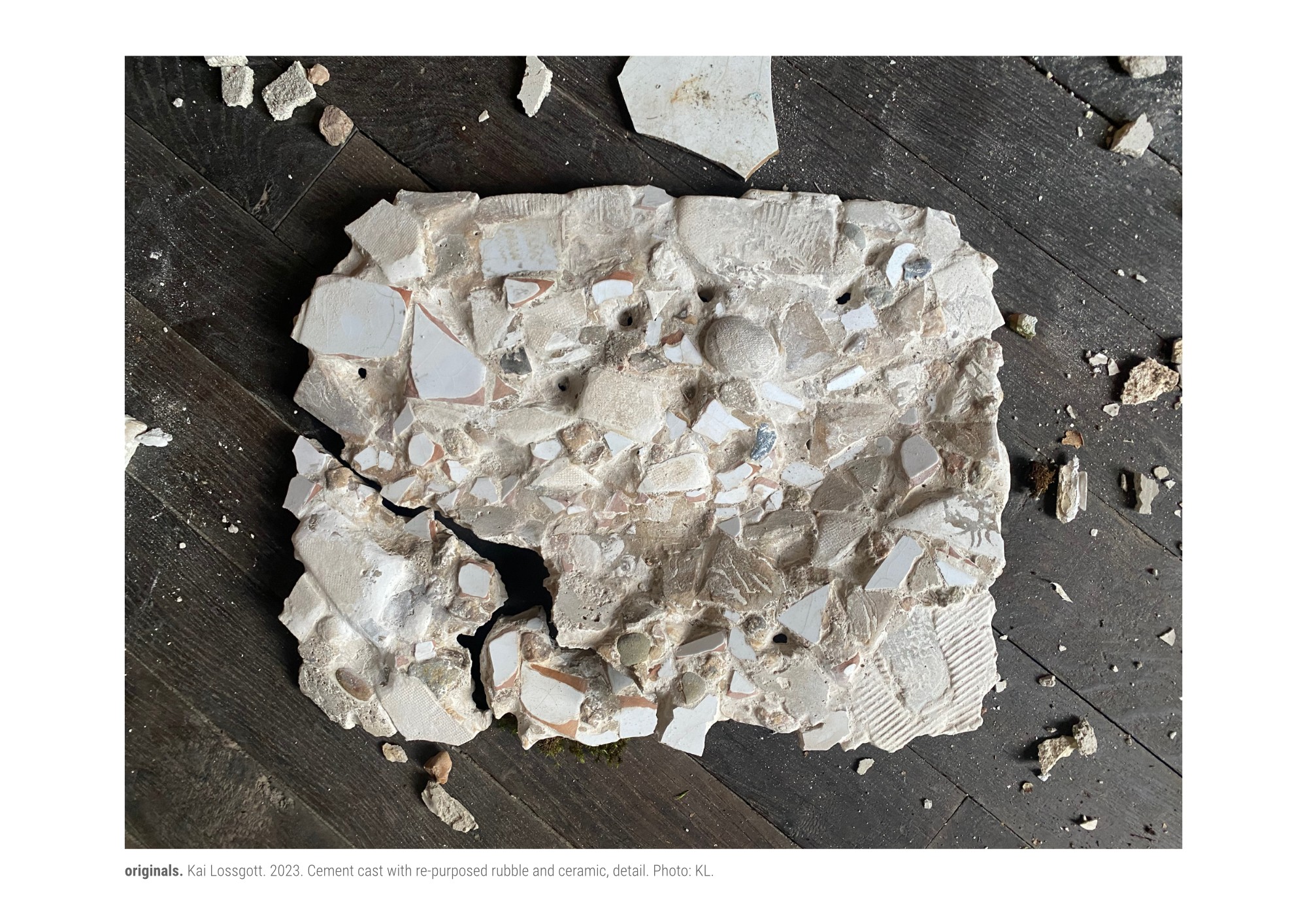
originals. Kai Lossgott. 2023. Installation with moulded and polished cement, re-purposed fragments of building rubble, ceramic, concrete, stones, soil, moss. Où est Adam?, Chapelle des Sept Dormants, Autun, FR. October 2023.
“I believe in One All, neither heaven nor earth, unborn and undying before all worlds, begotten, not made, in the image of the whole, whole from whole, true whole from true whole; being of one substance without story, in which all things, slowly, awaken from ignorance — unfallen, unbroken, unashamed — rise to remember in all worlds we are in.”
— KL, 2023
From the research sheet shown with the work (translated from the French):
What came first, the tree or the seed, the mould or the imprint? And which of them can lay claim to originality? Does the word depend on God, or God on the word? Who has the right to tell the story, and why does it matter which came first?
A work devoted to the mythical figure of the first woman, whom, we are told, God created in her own image (imago dei), like all of us, but to whom she did not give birth.
We are fashioned by the stories that inhabit us, especially our cosmologies: the images of the “universe” we tell ourselves we are in, conceived as one (uni), turning on itself (versus). In Christian theology, and therefore in European cosmology, in the beginning was original sin. Every human being is born guilty until proven innocent. The guilty one was Eve. She made a mistake, then came the Fall, and now humanity must pay. Through Christianity, we can see original sin give a form to the history of European culture: to shame, to dignity, to capital punishment and to human rights. Guilt becomes its own devil and its own god.
In his book The Core Wound of Unworthiness, the American Buddhist monk Adyashanti is struck by the fundamental lack of self-worth or low self-esteem felt by many people today. As a Westerner, he humbly explains that in Eastern cosmology, there is no original sin. It is simply a misunderstanding, and no one is to blame. We are all in a state of ignorance and have many lifetimes in which to learn from our experiences.
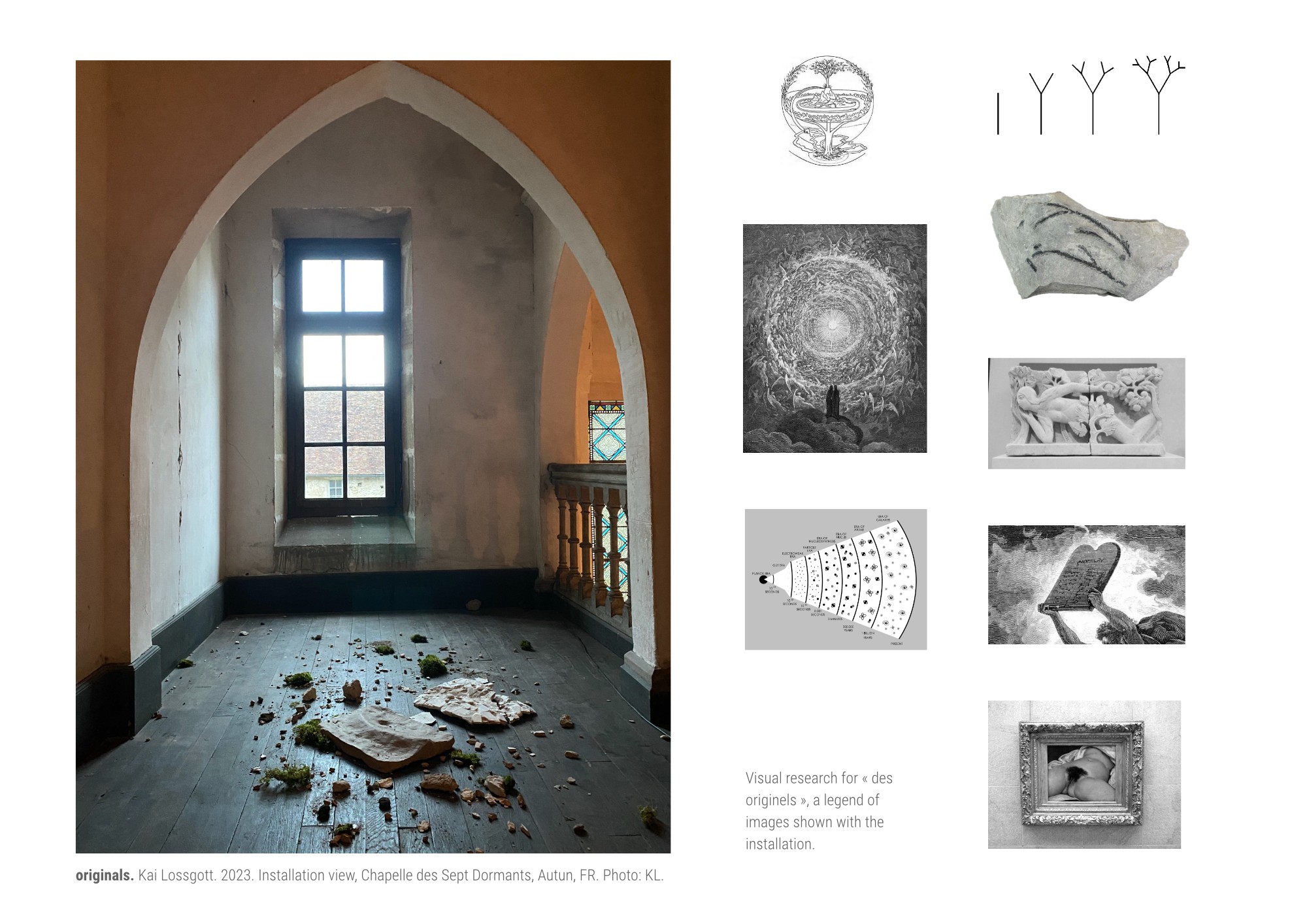
The casts were made at La Planchotte, Saint-Léger-sous-Beuvray, during the Franco-German artist symposium Où est Adam?, and laid on the floor of the chapel’s upper gallery. They were shown with a visual legend, a sheet of research images for des originels, the work’s French title:
Yggdrasil, the world ash of Norse mythology. 1824. Finn Magnusen, in Eddalæren.
Fractal trees. 1990. Matt Davis. Visualisation of C++ computer code.
The Divine Comedy, Paradise, Canto 31. 1870. Gustave Doré. Engraving.
Moss (Lepidodendron), fossil. 360–286 million years ago, Pennsylvania site.
Eve. Gislebertus, c. 1130. Lintel sculpture. Cathédrale Saint-Lazare, Autun.
Moses Breaking the Tables of the Law. 1870. Gustave Doré. Engraving.
The Big Bang theory. National Superconducting Cyclotron Laboratory (NSCL), Michigan State University. Illustration.
L’Origine du monde. Gustave Courbet. 1866. Oil on canvas. Musée d’Orsay, Paris.